COMPANYCAM
Combining the user-centricity of a Designer with the strategic thinking of a Product Manager to prove that good design can be good business.
Context: I worked as a hybrid PM/designer at CompanyCam, bringing alignment to an organization that had been moving fast without agreement on who it served, simplifying a product that had grown cluttered through years of independent sprints, and using AI-native prototyping to test and prioritize ideas faster than traditional design cycles previously allowed for.
Role - Product Manager
Year - 2023
Client - CompanyCam

Impact: Over the course of three years, I drove measurable impact across the different areas I touched. Highlights include, but are not limited to:
-
Created shared product language:
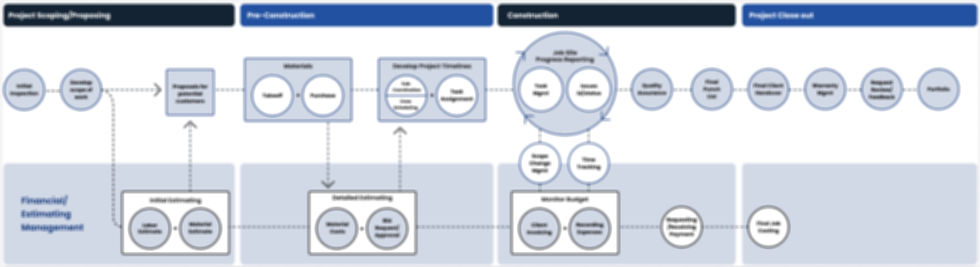
Built and evangelized the Operator persona and crafted the end-to-end journey map, creating a shared vocabulary for prioritization that was adopted across product, design, engineering, leadership, and even the CEO.
-
$100K in closed-won ARR
Launched Project Groups, helping growing teams organize related jobs and track work across multiple projects. The feature drove $100K in closed-won ARR and reached 11% daily usage within one quarter of launch.
-
15% NRR lift for communication features
Shipped multilingual communication features that helped English- and Spanish-speaking crews work together more easily, lifting NRR for communication features among multi-language teams.
-
Faster learning loops with AI
Built AI-assisted research, synthesis, prototyping, and coding workflows using Granola, Claude, Lovable, and Claude Code — helping the team validate ideas earlier and move from insight to implementation faster.
Unlike the project-specific case studies elsewhere on this site, this page touches on a few of my distinct contributions, each with its own measurable impact, that together show how I operate as a product builder who treats good design as good business.
Want the full scoop? Reach out and let's talk ;)

1. Creating shared product clarity
When I joined CompanyCam, teams were using demographic marketing personas to make product decisions. But those personas did not capture the complexity of construction work: in a 3-person company, the owner might also be in the field; in a 100-person company, the person coordinating work might sit in an office.
I led the shift toward needs-based product strategy by defining the Operator: the person accountable for knowing what is happening across jobs, crews, and projects. The persona and journey map helped teams onboard into the construction space, prioritize opportunities, and explain how our product decisions connected to real user needs.
Impact: Turned a broad, hard-to-prioritize market into a shared product language teams could actually build from.
2. Shipping features that created business value
The clearer our understanding of the Operator became, the easier it was to identify product bets that mattered.
Project Groups gave growing teams a way to organize related jobs and understand progress across multiple projects, supporting more complex construction workflows without forcing every customer into the same structure.
Multilingual communication features helped make non-English-speaking crews more visible inside the product, reducing the language gaps that often shaped who could participate in project communication. Together, these launches showed that better user understanding could translate directly into business value.
Impact: Proved that sharper user understanding could translate into shipped features with measurable ARR and retention impact.


3. Building an AI-native product workflow
I also developed new ways to move faster without skipping the human work of product discovery.
I used Granola to capture interviews, Claude to code insights against our opportunity solution tree, and Lovable to recreate product flows that I could test live with users. This gave us both the qualitative texture of the problem and a clearer sense of how often each opportunity appeared.
It also helped stakeholders see the future more concretely before we invested engineering time. Eventually, I used Claude Code to contribute production product code myself, extending my hybrid PM/designer practice into hands-on building.
Impact: Built a faster product learning loop from research to prototype to implementation — without losing the human signal.

